


1 - Everything is Full of Gods: Thales
Posted on
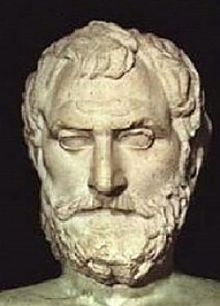
In this episode, Peter Adamson of King's College London introduces the podcast as a whole, and the thought of the early Greek philosophers called the Presocratics. He also discusses the first Presocratic philosopher, Thales of Miletus.


Themes:
Further Reading
K. Algra, "The Beginnings of Cosmology," in A.A. Long, The Cambridge Companion to Early Greek Philosophy (Cambridge: Cambridge University Press, 1999), 45–65
D.W. Graham, Explaining the Cosmos: The Ionian Tradition of Scientific Philosophy (Princeton: Princeton University Press, 2006)
E. Hussey, “The beginnings of epistemology: from Homer to Philolaus,” in Epistemology, ed. S. Everson [Companions to Ancient Thought: 1] (Cambridge: Cambridge University Press, 1990), 11-38



Comments
:)
Thank you! very usefull!
History of Philosophy Without Any Gaps -1
A good start P.Crates
nice
Looks like an ambitious project, thank you!
Thanks!
I enjoyed listening to this, looking forward to listening to the others and catching up.
Indian Materialism
Excellent broadcast but just one queory, if this genuinely is without gaps, why didn't you start with Indian Materialism which predates Thales?
In reply to Indian Materialism by Paul
Indian philosophy
Yes, several other people have queried this too. I do explain the reasons here in episode 1 -- there is some good reason to leave it out, in that my goal is to tell the story of Greek philosophy and its entire inheritance, not cover everything of philosophical interest that has been done in every culture. Of course there's Chinese philosophy too, African philosophy... Hard to know where to start and stop.
But the fundamental reason is utter ignorance on my part. It would be a steep learning curve for me and I think it would be worse to do it badly than not at all. Nonetheless I am increasingly thinking that I may circle back and cover Indian philosophy at some point. I guess if enough people demand it, it will be more likely!
Peter
In reply to Indian philosophy by Peter Adamson
thanks for the response. What
thanks for the response.
What little I know there is no good source on Indian Materialism in the English language, which is perhaps reason enough.
I have always held the prejudice eastern philosophy is not philosophy but religion, so am not really criticising you for that, I don;t think it belongs in this broadcast. It's just Indian Materialsim is different it's almost Greek in its take. No God, no supernatural, no life after death, all we have is sensory information and so on. I wonder how much Greek philosophy is actually derived from Indian Materialism?
In reply to thanks for the response. What by Paul
More on Indian philosophy
Hi there,
Actually I'm inclined to think, from what I do know, that there is a lot of very serious philosophy in the Indian tradition which is why I'm feeling guilty for leaving it out. So there's not only materialism but also Buddhist speculations about the self, and so on -- there are a lot of resonances with Greek Neoplatonism too. A course is actually offered on it at King's, but it isn't taught by me!
Aptly, the episode I just posted today mentions the possibility of Indian influence on the first Greek skeptic, Pyrrho.
Peter
In reply to More on Indian philosophy by Peter Adamson
The Shape of Ancient Thought
Excellent series!
There is a book by Thomas McEvilley called "The Shape of Ancient Thought" which traces developments in Indian and Greek philosophy in parallel, and shows many similarities between the views of the Greek thinkers and views found in the different Upanishads and later Indian texts. I am not sure how "mainstream" McEvilley's views are in the Academy, but at least the similarities seemed striking to me, whatever one makes of his interpretation of Greek thought being influenced by Indian thought earlier (and vice versa later in time).
I have studied many of the ancient Indian works, and I can certainly say that there is a lot of philosophy in them.
In reply to The Shape of Ancient Thought by Omkar
More on Indian philosophy
Hi -- thanks very much. Yes, I definitely agree that the Indian tradition has serious philosophy in it and, whatever one thinks about possible historical connections (here I'm skeptical from what I've seen) there are certainly plentiful parallels. In Indian thought we find for instance atomism and monism and element theories, so many of the ideas present also in the Pre-Socratics, and there is a rich literature of inter-school debate as well. As I say I am increasingly thinking I will come back to this at some point.
In reply to More on Indian philosophy by Peter Adamson
Indian Philosophy
I personally wouldn't rule out exchanges of ideas between the Vedic cities and Greece, if not directly but by trade and possibly by travellers. We forget how incredibly mobile people were back then and that trade between Mesopotamia and India dated back thousands of years to the Indus Valley civilisation.
As for the Indian Materialist's views, I don't see a lot there the Greeks didn't come up with too, but it took them several centuries to do so. So I have to ask the question, does this suggest it took the Indians several centuries to get to this position too, and what we are seeing is the end result of a tradition dating back centuries?
In reply to More on Indian philosophy by Peter Adamson
Indian Philosophy - prebuddhists
I have enjoyed listening to your podcasts, but then I wonder why you have focused on Buddhist and later philosophers more than the Upanishads and Darshanas.
In reply to Indian Philosophy - prebuddhists by margie parikh
Early Indian thought
Well, we did cover the early Upsanisads at least - I am not sure which texts you missed covering but I guess the basic answer is that we tried to cover a wide range of literature but focused on the most obviously philosophical stuff, hence dealt with the main Brahminical schools and tried to do justice to the Buddhist and Jaina thinkers. I tend to think that we covered everything with a similar amount of depth, i.e. some but much more detail would have been possible!
In reply to thanks for the response. What by Paul
Indian materialism
There have recently been articles in Indian philosophy journals on Indian materialism, including translations into English of whatever fragments and quotations we have from materialists. Ramakrishna Bhattacharya is the name of an author who has published many such articles on Indian materialism in academic journals.
In reply to thanks for the response. What by Paul
"I have always held the
"I have always held the prejudice eastern philosophy is not philosophy but religion"
Religion and philosophy can sometimes be so intertwined in our Eastern culture that its difficult to talk about one without the other. However, if you look at Western civilization and its history before 15th centuries, they actually are not much different.
Philosophy is just a way to express a worldview padded with logics through a series lens of religion, culture, civilization and history.
In reply to thanks for the response. What by Paul
Greek philosophy and religion
When we look at Indian philosophy and Islamic philosophy we notice that they weren't there as parallels rather you see a unity between both religion and philosophy. However, in Greek philosophy it can be seen that religion didn't play a major part or maybe it isn't covered. Like I would like to know how Thales theory of water or Anaximander's and Heraclitus's theory of fire was affecting (if affecting) religion side by side. And the philosophical changes were altering religion in Greece.
Thanks and love.
In reply to Indian philosophy by Peter Adamson
Indian philosophy
Wow You work so hard already! It might be better to be an expert in your field rather than trying to be all things to all people. Do the reading for your own interest but don't give yourself a nervous breakdown!
I am looking forward to the rest of the series after this intro. Thank you very much for the free access.
In reply to Indian philosophy by Outlaw Josie
Indian
Well actually I did take the plunge, if you look at the headers above you'll see there are about 70 episodes on here about Indian Philosophy! Enjoy the series.
What is a soul? Do magnets have souls?
Can you give any meaning to the word "soul", beyond using it is a synonym for "mind"?
Let's assume, for the moment, that "mind" is another word for "soul".
If brains have minds (souls), then don't *all* lumps of matter, not only magnets, have souls? We have found that all matter is energetic, with electrons and atoms whizzing about. If anything active has a soul, as Aristotle said, then everything has a soul - even the vacuum at absolute zero shows quantum fluctuations, so even "nothing" has a soul, if Thales is right...
In reply to What is a soul? Do magnets have souls? by Malcolm
Soul vs mind
That's a good question. In the Platonic and Cartesian tradition soul often is treated as nothing more than the mind -- the rational soul, or thinking soul. You might get that impression from the Phaedo for instance. But of course even Plato in the Republic recognizes lower parts of soul (appetite and spirit). Aristotle discusses the issue at length in De Anima Book 1 and decides that what "soul" means in general is a principle of life, motion and thought. Thus for him, plants have souls but rocks don't. Many ancient philosophers, again including Plato, also think the world as a whole is alive and thus has a soul (the "world soul").
Nowadays, though, I don't think most people would consider something like the capacity for digestion or locomotion to be indicative of the presence of soul; we associate it more with consciousness or awareness. It's an interesting question when this whole notion of "consciousness" comes into philosophy as something distinct from particular kinds of cognition (thought, perception, imagination). Maybe with the Neoplatonists, actually.
In reply to Soul vs mind by Peter Adamson
Ghost or motor?
Isn't appetite mental? Why couldn't Plato say that it's a lower part of the mind?
Was Thales idea of the soul closer to Aristotle's? Does Thales have any conception of the soul as an immaterial thing that survives after death?
The "Oxford Companion to Philosophy" suggests that, for Thales, the soul was a sort of motor (kinetikon). The magnet has a soul because its motor moves iron. So I guess any old rock doesn't have a soul 'cause it doesn't have 'a motor'.
Two incredibly different ideas of soul here! Ghost or motor? Flip a coin :)
In reply to Ghost or motor? by Malcolm
Ghost in the machine
I think that the reason Thales thought the magnet has a soul is that it can _initiate_ motion, most obviously when it moves itself towards some metal. (So, imagine you've got a magnet just sitting there, minding its own business; then some metal comes along and it seems to move itself towards that metal.) But that's just a guess of course.
You're right that Plato's appetitive and irascible souls could be associated with "the mental," my point was just that he seems to recognize that the soul has more parts than just the bit that does thinking. There is also emotion (spirit) and desire (appetitive soul). It's an interesting question what these functions come down to -- remember the Stoics thought that desires, for instances, are just beliefs, but I find it hard to believe that this was Plato's view.
In reply to Soul vs mind by Peter Adamson
Soul and rocks, plants...etc
"Thus for him (Aristotle), plants have souls but rocks don't". I came across this interesting Daoist belief that : in rocks, consciousness is asleep, in plants it dreams, in animals it is awaken, and in human it is fully operational...
Love your podcasts.
In reply to What is a soul? Do magnets have souls? by Malcolm
Animism
I believe that this view of Thales is due to animistic tendencies throughout our early civilizations.
Thales and Marriage
A famous aphorism of Thales suggests that up to a certain age a man is too young to marry, and after that he is too old. Did philosophers take this aphorism to heart? Does this explain why so many philosophers did not marry? Are there any other ethical aphorisms linked to Thales? Did he have an 'ethical system' that is now thought to be lost?
In reply to Thales and Marriage by Malcolm
Should philosophers marry?
In reply to Should philosophers marry? by Peter Adamson
Exceptions? Epicurus?
Epicurus (VS51) thought seeking sex for pleasure was OK, as long as it didn't lead to pain, but suggested it has never done anyone any good. Did he believe in marriage? He stressed self-sufficiency and 'easy tranquility', so this is, surely, doubtful.
Dobbin says tradition has it that Epictetus also retired to a happy family life in later life. Might these "happy late marriage" stories be tall-tales told, or maintained, by Christians?
In reply to Exceptions? Epicurus? by Malcolm
Hellenistic views on marriage
Epicurus actually recommends in an extant letter not to have children (which I take it means he would recommend not getting married). And actually since I posted yesterday I came across a reference to the fact that Epictetus' teacher Musonius Rufus did accept that partaking in sex should be a part of a life lived in accordance with nature -- so the sage would not be celibate.
Thank you so much.
I love this podcast. I listen each episode several times. I studied engineering in university and somehow I regretted the fact that I'd lost the chance to study philosophy. Now I am so content to listen to "History of Philosophy" lessons of a great professor. Thank you and good luck.
In reply to Thank you so much. by Philosophyphile
Engineering and philosophy
And thank you! It's appropriate that you left this comment on the Thales episode, because he was also something of an engineer (supposedly). I'm glad you are enjoying the podcast.
Objectivity of Philosophy
Hi Professor,
If it is to be taken that the philosopher is an active part of his society, a living individual in a specific economical, political, cultural and historical setting, what effect would this have on the objectivity of philosophy as a 'search for truth' or 'search for wisdom'.
Or is it even the goal of a philosopher to be 'objective' (whatever that means) as it is 'claimed' by the physical sciences in the 21st century? I guess in the time of Thales and subsequent classical philosophy 'truth' was broader as philosophy included the physical sciences. But if we are to suggest that philosophy has a direct historic continuity from Classical times to the contemporary era, what can we say regarding its search for 'objective' truth?
Thanks for the podcasts
In reply to Objectivity of Philosophy by Aron
Truth
First let me echo a "thank you" Professor for these podcast.
Aron,
I believe your questions will be answered when the struggle for truth beyond the present cultural, economic and historical setting came to a head during the "golden age of philosophy". The Sophist took this to the extreme in that there was no truth. Rhetorical argument could be effective from any viewpoint or assertion. A small amount of these Sophist sold themselves to political use becoming the first effective speech writers. They where so effective that the entire school of thought was eventually condemned and obliterated. This is where words like "Sophisticated" have their origins. Many of the Sophist views where used in the formation of the scientific principals and had a rebirth however, these rhetorical philosophy arguments have never since been joined to a cultural standard (in common use). This is my favorite historical period and I am looking forward to these podcasts covering that age.
Cheers
What is Rational???
I can't help but wonder what people see or define as "rational" since without a commonly agreed definition of 'rational" we are speaking gibberish. Some would say rationality is just the application of a mathematical concept to behaviour/choices where 1 +1 always = 2 for every single human mind.
When we say Homer and Hesiod were rational does that plumb with our contemporary view of "rational".
For instance, most of what we do in our lives (or what Homer and Hesiod said) appears rational since our minds calculate what we have on hand and allow us to decide what the rational path is, but is that just irrationality in the guise of rationality, kind of like mistaking a Sophist for a Philosopher.
We truly need a definition of rationality to act as a first principle of sorts, a foundational premise before we can progress toward knowledge and then if we're lucky toward wisdom thereafter.
Soul in Magnets?
Can we say a magnets soul is synonymous with its equation, its animator and if so Thales is on to something.
or
"Gods are in everything" as a way of saying perfection is in everything, the perfection being the equation ( or the subset of the One, the Monad)
Thoughts anyone?
If possible, please fix RSS/XML feed
This is a wonderful (and I note, free of charge) resource. However, I am not able to enjoy it as a "podcast" because I do not (and refuse to) use iTunes, and the RSS/XML feed does not properly provide the audio content. In any case, it is still easily accessed (just not as advertised.) Thank you.
In reply to If possible, please fix RSS/XML feed by Patrick Moore
Philosophy only please!
Please only post philosophical comments here. If you scroll to the bottom of the screen you'll see a direct email for the web designer - that should be used for reporting technical faults. Users of this forum want to take part in philosophical discussions, not hear about your trivial technical problems. Imagine interrupting Thales discoursing on his theory of the universe by saying, "my fridge doesn't work...".
In reply to Philosophy only please! by Mal
Dear Mal, Thank you for the
Dear Mal,
Thank you for the correction. I will indeed re-direct my concern there.
However, I disagree that it is trivial, even though it is technical, and given the asynchronous mode of our discourse, it is hardly an interruption.
In reply to If possible, please fix RSS/XML feed by Patrick Moore
RSS feed
Which RSS link are you using that doesn't work? There is one under Links in the menu above that seems ok and then there is an RSS button on the right sidebar of each episode that takes you to episodes for that series of episodes on Feedburner.
In theory I guess the general comments page might be a better place for technical questions but it's definitely worth clearing up if there is a problem so thanks for letting us know.
In reply to RSS feed by Peter Adamson
that works!
Thank you! (Finally following up a few weeks later...) Yes, Go to Links->RSS seems to be a proper feed. I forget which link I had been trying three weeks ago but it was not that one...
This is really great. I'm in
This is really great. I'm in my last year of high school and i'll study Philosophy, and I love the concept of telling the history without any gaps. Like you said, many schools/universities jump a few thousand years and leave important thinkers behind that were needed for proper understanding of the more modern ones. Will listen to the whole thing! Thank you.
In reply to This is really great. I'm in by Rafael
The whole thing
Thanks! I hope you enjoy the series. Please get in touch to let us know what you think. (And if you wouldn't mind, tell your fellow students about the podcast when you get to university...)
Thanks
Many thanks to Peter Adamson and King's College London for this rather ambitious series. I am not a student, merely a guy who likes to read. I have spent many hours reading and rereading Kirk and Raven. I enjoyed this lecture very much. I thought it struck an appropriate balance between a thorough examination of what can be inferred from the extant fragments, and the approach taken by many introductory texts, which might mention that he thought that magnets have souls, or that everything was made of water, and little else.
I look forward to listening to the articles on Heraclitus and Parmenides. Keep up the good work!
In reply to Thanks by Steven
Thanks likewise
Great, I'm glad you enjoyed it! The series actually gets much better after the first few episodes actually (I have even considered re-recording these first ones but that seems like cheating, somehow).
Thank you
Thank you for these podcasts. I have being wanting to learn more about philosophy and this helps so much.
With kind regards,
Jeroen
Thank You
I just started listening to your podcast and appreciate what you are doing!
First episode
Did you re record this??
In reply to First episode by David Milner
Re-recording
Yes, well spotted - I'd actually been meaning to do it for ages because the sound quality and delivery weren't as good as later episodes, but I finally did it now because in the original version I'd said I wasn't going to do Indian philosophy, which of course is now no longer true.
The start of something special
First listened to this episode many years ago now; just want to show my appreciation for what's been a fantastic set of podcasts and what has really got me into philosophy (you are partly responsible for me needing another bookshelf just for philosophy books). Thanks again.
In reply to The start of something special by Anonymous
Thanks
Thanks, glad you have enjoyed the series! As you might imagine my bookshelves have also needed to expand...
I have just discovered your
I have just discovered your blog through my Ethics class and I am so glad that I did. Very detailed and yet, not in a monotonous way.
Add new comment