


39 - Form and Function: Aristotle's Four Causes
Aristotle's Physics presents four types of cause: formal, material, final and efficient. Peter looks at all four, and asks whether evolutionary theory undermines final causes in nature.

Themes:
• J. Annas, “Aristotle on Inefficient Causes,” Philosophical Quarterly 32 (1982), reprinted in T. Irwin (ed.), Aristotle: Metaphysics, Epistemology, Natural Philosophy (New York: 1995).
• D. Charles, “Aristotle on Hypothetical Necessity and Irreducibility,” Pacific Philosophical Quarterly 69 (1988).
• C.A. Freeland, “Accidental Causes and Real Explanations,” and J.M. Moravcsik, “What Makes Reality Intelligible? Reflections on Aristotle’s Theory of Aitia,” in L. Judson (ed.), Aristotle’s Physics: a Collection of Essays (Oxford: 1991).
• S.S. Meyer, “Aristotle, Teleology and Reduction,” Philosophical Review 101 (1992).
• D. Sedley, “Is Aristotle’s Teleology Anthropocentric?” Phronesis 36 (1991).
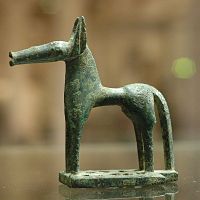
Aristotle


 ..
..


Comments
Aristotle and the causes
Your recording was really helpful! I have an exam on Tuesday and this has really helped me understand :)
In reply to Aristotle and the causes by Lateesha
Exam on Tuesday
Great, I'm glad -- please spread the word! And good luck on the exam.
In reply to Exam on Tuesday by Peter Adamson
Darwin and the facts
I must say, Professor, I am astonished at your absence of knowledge of the failure of evolution theory. I simply suggest to you this book by Robert Geis, "On the Existence of God" (published by Rowman and Littlefield). It contains two chapters on evolution which decimate any pretensions that evolution theory has to being anything but a point of view backed neither by science nor the laws of probability. If Philosophy instructors are of your calibre only, God help the students of the future who have not been schooled in the riigors of reasoning and mathematics. Your acceptance of Darwinism or evolution theory shows a fatal ability to reason either correctly or persuasively.
In reply to Darwin and the facts by Dorothy Palmer
Evolution
Well, I'd rather this website didn't become a forum for people to argue about evolution -- I believe the internet has no shortage of places to do that. As far as its relevance to Aristotle is concerned the point of raising it in the episode was that he believes in the eternity of the species and in a teleological account of nature. Presumably the vast majority of listeners do in fact believe in evolution and so would have an immediate objection to Aristotle's view. Also it is interesting to see that Empedocles has a view that is akin, if not identical, to modern evolutionary theory. So I wanted to talk about how strong Aristotle's position was given the dialectical situation at the time.
If you happen not to believe in evolution (and believe in a creationist theory instead) then you would however have a different problem with Aristotle, in that his god is not a creator but simply causes the eternal motion of the cosmos, which indirectly (and permanently) gives rise to animal species. As we'll be seeing when we get to medieval philosophy there were many attempts to try to harmonize Aristotle's views with a more creationist metaphysical/theological system.
Peter
In reply to Evolution by Peter Adamson
heuristic...
I think it is not uncommon for scientists to prescind (a word I like a lot) from teleology since it cannot be tested yet to privately hold a common sense notion of purpose. A difference between doing science and appreciating nature. The search for a chemical that attracts sperm to egg does not keep us for cheering for the little swimmer that seems to be winning the race as an allegory of our own search for love.
In reply to Evolution by Peter Adamson
Aristotle and Darwin
Hi Peter,
Late to the party but I am enjoying your series on Greek Philosophy. In regard to representation of evolutionary theory, a few distinctions are in order. Yes, you will love this.
Macro evolutionary theory is in regard to origins of the big things -- the universe, life and species from one to another. Micro evolutionary theory is about how traits are inherited within a species or family of species. Darwin's theory and the specific nondirected mechanism of random mutations eventually selecting fittingness for survival is inadequate as it relates to Macro theory and is not taken seriously by anyone who is truly interested as opposed to those promoting an ideology. I emphasize that creationism has nothing to do with it. With the advent of DNA, and the machine software code it implies by which amino acids are configured and build proteins, even atheistic biologists concede the Darwin mechanism could never iterate to a universe let alone life on planet earth with the probabilistic resource available of 13 billions years. Not enough time. Put differently, a monkey at a keyboard could never type out Hamlet given 13 billion years which is 1/1,000,000 of the complexity of one protein used in vision -- regardless of how Dawkins games the problem in his book (namely, that sensical phrases are retained by the monkey! but why? implies a directed process to a goal or teleology thus refuting the very point Dawkins is trying make). Darwin may explain survival of the fittest. HE DOES NOT EXPLAIN THE ARRIVAL OF THE FITTEST. (yes, you can reuse that). However, any horse and dog breeder knows that genetic traits can be selected for fittingness -- Darwin's finch beaks are all examples of micro evolution not speciation. Darwin also acknowledged that if the fossil record does not improve from his time, then his theory would be busted. The fossil record, if anything, reflects abrupt change in speciation (Cambrian), not the gradual non directed process Darwin envisioned. The earth should be covered with fossils showing intermediate skeletons. Thus, attempts to invent/extrapolate/conjoin disruptive events to explain a limp fossil record. In any case, one can hold both a teleological universe (macro directedness ala Aristotle/Aquinas) and micro evolution as tools of causality that are completely compatible with each other. Just ask Mendel.
Hope this helps. For more, read Stephen Meyer, Signature of the Cell or Darwin's Doubt.
Charles
In reply to Darwin and the facts by Dorothy Palmer
Evolution and reasoning
I understand that this thread is at least five years old but it seems to me that the last sentence of Professor Palmer's comment deserves its own answer:
She wrote there, "Your acceptance of Darwinism or evolution theory shows a fatal ability to reason either correctly or persuasively." I imagine given the rest of her comment that she meant a "fatal inability to reason." If you meant "ability" I suppose the author of the post would agree with you. Reasoning needs only to be correct: correct reasoning must be persuasive unless its hearer is not bound by sanity or it is not truth reasoning. I believe it was the poet William Blake who said, "The Truth cannot be heard and not believed."
A last comment, I am sure God, if God exists, helps all students.
In reply to Evolution and reasoning by Carridine Poran
Yes, the Truth is far from us
Yes, the Truth is far from us, but when we speak of theory we should present it as a theory.
I don't think its right to say, as Prof Peter did in this podcast, "Poor Aristotle's teleological believes is ultimately shown to be wrong by the theory of evolution" and again "Aristotle's teleological theory is quite literally antiquated" because it gives an impression that the theory of evolution is the ultimate truth.
In reply to Yes, the Truth is far from us by Hen
Poor Aristotle
In the very next sentence I say "But things are a bit more complicated" and then explain that Aristotle knew of a theory like evolution, namely from Empedocles, and discuss his refutation of it. What you quote here is (and I think obviously, if you listen to the episode) just a straw man I was setting up to knock down. That happens a lot in the podcast: I present a common misconception and then explain why it is wrong.
In reply to Darwin and the facts by Dorothy Palmer
WRONG
Stop troling Dorothy, evolution makes much more sense than creationism.
In reply to Darwin and the facts by Dorothy Palmer
evolution
Interesting idea and of course biological theories are called as such because they are scientific, but if we are to deny the existence of science we maybe calling into many of Aristotles theories to do with observation. I think if you asked my father to choose between a theory based on him playing in a sand pit or buiding a fully functioning spacecfaft he would choose the latter, but whatever if it is important that you should continue along the lines literal formulaics it is unlikely that you will rise to the of Aristotle and even Darwin sometimes you need that gift of faith that father imbued in Darwin so that he may believe that his creation is intelligent enough to change according to its environment
Aristotle's Final Cause
Peter,
Your podcasts, lately discovered, are, dare I say, a godsend: well written, well spoken, with just the right dash of levity. Having received but a B.A. in Philosophy more than 30 years ago, I am enjoying this review from a great enough distance to accept the premise that there are no apparent gaps. That is until Lesson 39.
I am somewhat dismayed by your dismissal of Aristotle's final cause. You offer Darwin's theory and genetics as sufficient evidence of the randomness of nature to dispatch the notion of any purpose to life. Your suggestion that design in nature is but apparent begs the question.
Today, many philosophers and scientists seem to reflexively disregard the issue of intelligent design to the point where they become impatient with anyone who questions this self evident truth. Their ability to apprehend this "universal negative" is laudable but I am frustrated that I am not able to comprehend the non-intelligibility of existence and our consequent purposelessness.
Peter, if anything, you have proved yourself patient, both in the preparation of this series and in your careful response to those who offer comments. Can you explain how it is that existence has no final cause or purpose?
While you may say the burden of proof is with me to prove that there are final causes, I would refer to Aristotle's observation of nature. His argument is inductive. I would suggest that it is also demonstrable.
I accept that, from a philosophical, i.e. rational perspective, we cannot determine what the final cause or purpose of a giraffe is. But it does not follow that there is then no final cause or purpose to a giraffe. Again, even though we do not know WHAT that purpose is, there seems to be evidence in its design THAT there is a purpose. I believe that this was the observant Aristotle's main point about final cause.
The further details admitted by later scientific observations do not disprove this point. To argue against Aristotle, it seems that one must either describe the evidence absurdly as "nonintelligent design" or as "intelligent non design." In describing it in your lecture as "apparent design" you seem to be leaning towards the latter position.
I would think that philosophers would be the first to defend the notion of purpose. For if there is no purpose to existence then philosophy is the most meaningless of all intellectual pursuits. All philosophy, including Plato, would be but a footnote to the more practical sciences.
In reply to Aristotle's Final Cause by Bill Harder
Purpose in nature
Thanks for this thoughtful post. Maybe I should listen back to what I said in this episode but I think all that I was trying to say is that Aristotle's insistence that regularity cannot be explained through a chance process seems unfounded: Darwinian theories of evolution seem to do precisely that. However, this is a fairly narrow issue about his argument in Physics II.7. More broadly, I think there is good reason to say that we cannot avoid invoking purpose in talking about nature. Leaving aside the debate about intelligent design, it is hard to imagine that biologists could get around saying things like "the giraffe's neck is for the purpose of reaching leaves." If this is right then purposiveness plays an explanatory role in our accounts of nature, but this leaves open the question of how things got to have these purposes (evolution, intelligent design, whatever).
It's perhaps worth noting that Aristotle was not a believer in intelligent design. He did believe in God but his God is not a designer -- that would be Plato's view (albeit that Plato talks of "younger gods" who help the divine craftsman to design lesser entities, for instance the human body). The Aristotelian God is invoked to explain the regular and eternal motion of the heavens, and we are never given even a suggestion that this God put thought into how animals should be structured, or anything like that.
This just goes to show that the question of purposiveness in nature needs to be kept distinct from the question of intelligent design. Darwinian biology and Aristotelian biology can (and do) make free use of "purpose" vocabulary, without either kind of biology ever invoking a superhuman intelligent designer. Thus if we do want to argue for such a designer we need to do more than just point out that nature sometimes seems purposive; further argument is needed, and of course further arguments have been given! (Stay tuned for medieval philosophy...)
In reply to Purpose in nature by Peter Adamson
Purpose and design
Thank you Peter for both distinguishing and seperating the issues of purposiveness and intelligent design. I do wonder how this seperation would hold up under the rigourous scrutiny of the scholastics. So I will indeed stay tuned and, like Achilles chasing the hare, expect to be on your heels by the time you get to Medieval Philosophy. Then, following at the more leisurly pace of a peripatetic, I hope to find more purpose in your well-designed pods.
In reply to Purpose and design by Bill Harder
evolution of purpose
For a lecture on this very topic by my favorite philosopher of science, Daniel Dennett, try:youtube.com/watch?v=3L7uNyQL0H0
(You can skip the first two minutes of introduction,which is dry as dust.) I hope I am not giving away too much by quoting an early critic of Darwin (1868)who claimed his theory was a strange inversion of reasoning: IN ORDER TO MAKE A BEAUTIFUL AND PERFECT MACHINE IT IS NOT REQUISITE TO KNOW HOW TO MAKE IT (caps in the original). I realize that the whole video is over an hour long, but it is well woth watching.
In reply to evolution of purpose by machintelligence
Dennett's Darwinian Design
Thank you for the link to Prof. Dennett's lecture. While I found his distinction between "What for?" and "How come?" interesting, his anecdotal presentation about the evolution of the question "Why?" did not prove his main point that our "intentional stance" is but "a good trick" we play on ourselves.
The professor is indeed following a strange inversion of reasoning in that he seems to mistake a branch of the evolutionary tree for its root. For though the artificer need not know how to make a beautiful and perfect machine in order to produce it, there must at least be someone with a notion of beauty and order to declare it "beautiful and perfect."
Further, by denying any distinction between replication (by external, cyclic forces) and reproduction (by internal self-organizing individuals) Prof. Dennett ignores rather than disproves the argument for purpose. This reduction of the question of final cause to one of efficient cause is itself a pretty neat trick. Dare we suppose it was intentional?
Finally, merely explaining how our interest in the question "Why" might have evolved still leaves the question unanswered. His lecture, while entertaining, in the end appears to lack any true philosophical purpose.
Okay, tell me if I got this right...
The formal cause of the History of Philosophy podcast is Peter Adamson's voice, the material causes are sound waves and data files, the efficient cause is Peter Adamson, and the final cause is the entertainment and education of strangers?
I love these podcasts Peter, thanks so much for lending them your lucidity, hysterical wittiness, and attractive voice. Without these podcasts my summer would be far more dull than it currently is. An enormous kudos and the most sincere approbation from me and all your listeners across the pond.
I'm interested in the
I'm interested in the antiquated final cause in the biological sciences. While you say that an animal's final cause is now nothing more than survival pressures and genetic inheritance, couldn't these very ideas be translated into Aristotelian causes? Genetic make-up looks a lot like the formal cause of each trait and "survival pressure" is more or less a negative statement equivalent to "for the sake of survival." I just don't see a real reason to reject final cause due to Darwinism.
also, the podcast is wonderful.
In reply to I'm interested in the by Noah
Final cause
Glad you enjoy the podcast. I think I agree with you -- I mean the idea that "in order to survive/reproduce" could be in some sense a final cause. The only thing is that this suggests a deflationary understanding of final causes. What I mean is that speaking of a final cause in this sense could be reduced, and hence eliminated, with a story about which ancestors survived -- effectively translating the final cause into a long story about efficient causes. Now, some people would be pretty happy with this kind of deflationary interpretation of Aristotle. That is, they would say that for Aristotle any causal account that invokes final causes can also be translated into a causal account about efficient causes. But I find this implausible; I think he wants to have a more "realist" account of final causes, where such causes cannot be eliminated from the best scientific explanation. Does that make sense?
Peter
In reply to Final cause by Peter Adamson
final cause
Thanks for the quick reply. I guess a Darwinian final cause would become equivalent to the efficient cause, because the animal's purpose in survival is to become an efficient cause? But wouldn't that still provide slightly different knowledge, because it is not becoming its own efficient cause, but that of another? I certainly don't want to deflate the meaning of Aristotle's causes. Would his "realist" account of final cause translate into something that's of meaning to another thing (the designer or efficient causer?) as in the case of man made things which are designed for a purpose with specific reference to the intelligent being/ designer? I believe in Plato's Symposium Diotima claims that the final cause (final desire) of all mortal creatures is to become immortal. Is this along the lines of Aristotle's "realist" account of final cause? This of course suggests nothing about the benefit it provides to intelligence, unless intelligence is immortal.
In reply to final cause by Noah
more on final cause
That's not quite what I meant about final causes. What I meant is that the Darwinian story might be taken to say: "ok, it looks like these animals have teleological features, like sharp claws, long necks, etc. But we can explain away the apppearance of final causes by appealing solely to efficient causes: namely the mutation of genes, the killing of less survival fit members of species, and reproduction. This is how we get apparent purposiveness out of a random process." This would be sort of like other reductionist moves in philosophy, e.g. it seems that there is some real thing that is mental consciousness, but it can be explained away as merely the product of physical processes in the brain (not saying that's true, just that it's a similar move).
I don't think either that Aristotle needs to say (nor does he say) that purposiveness has to be the result of deliberate, conscious design, e.g. by God. Rather I think he just believed that nature itself is characterized by purposiveness, without any conscious agent having imposed the purposes or designed the animals, plants, etc.
In reply to more on final cause by Peter Adamson
Ok thanks, that helped to
Ok thanks, that helped to clarify things quite a bit.
I'm still not entirely comfortable with such a reduction of the final cause, but I see how it is achieved, more or less.
Final Cause, Once Again
Peter, about this claim, which I take to characterize your position (in your words) "I think [Aristotle] just believed that nature itself is characterized by purposiveness, without any conscious agent having imposed the purposes or designed the animals, plants, etc." If what you mean by "characterized by purposeness" is that biologists must think in terms of purposeness for the sake of knowledge in their science (in your words again "it is hard to imagine that biologists could get around saying things like 'the giraffe's neck is for the purpose of reaching leaves.'") - I think this is wrong. If final causes are reducible to efficient in biology, the biologist is simply using shorthand by saying 'the giraffe's neck is for the purpose of reaching leaves'. The full claim, and the claim that is deposited as knowledge in the bank of biology, reads 'the giraffe has a long neck as a result of natural selection where this trait proved itself advantageous in survival over its absence.'
A second point Peter, an echo from the Phaedo. Socrates speaks about muscle, tendons, locomotive force, etc. as able to provide a very complete and powerfully explanative picture about why he is in prison. But unfortunately the wrong picture. The right picture cannot be given without reference to the idea of the good that he Socrates followed to arrive at his difficulty. I am saying that the judgment between the two pictures may not come down to how much each is able to explain.
In reply to Final Cause, Once Again by Gaurav Singhmar
Purposiveness
Thanks for the comment! On the Phaedo point first, maybe I'm missing your point but I think you have Socrates' idea backwards. What he says in that passage is exactly what you are saying: he insists that we cannot explain his sitting in prison only by referring to muscles, tendons, etc, rather we need to invoke his conception of the good.
The Aristotle point is trickier. I think your remark relates to what I was saying about deflationary accounts of teleology in Aristotle. So the idea here is that Aristotle could be made closer to modern biology if we said that for him, final causes are necessary for explanation, but not necessarily "causes" in some fuller ontological sense. I guess you want to go even further and say that biologists now don't even need to invoke purposiveness in providing explanations: rather you can do everything with efficient causes. The question here is whether, as it were, the "finished perfect biology" would still have purposive language in it. I think your rephrasing about the giraffe does manage to avoid this, but only by leaving out a crucial part of the explanation. Why, we might want to know, is the neck "advantageous in survival"? Because the neck helps the giraffe reach leaves; that is the "purpose" of the long neck, albeit not a purpose imposed deliberately by anything. So the idea here is to say that the long necks emerged due to natural selection, but also that there is something the long neck is good for. Similarly with, say, bright feathers: they are "in order to attract a mate" or "good for frightening predators" or whatever. So what I was suggesting is that biologists will find it hard or impossible to fill out evolutionary accounts without using purposive descriptions in this minimal way. I'm not necessarily claiming this is right, by the way, it is a tricky issue which would take us into philosophy of biology, but I do think it's plausible.
Peter
Great podcast
Great treatment of the four causes!
Could I ask, what was the prevalence, enunciated and tacit, of the final cause in pre-Darwinian thought? Was Aristotle's classification of intention as 'metaphysically real' really the common conception in culture up to that point? If so, what spurred Darwin and his contemporaries to attempt to move away from such a deeply entrenched paradigm?
In reply to Great podcast by Denziloe
Darwin vs Aristotle
One thing to emphasize here is that final causality does not, or doesn't necessarily, involve actual intention. Aristotle clearly distinguishes voluntary agents from natural causes like trees, and never says that anyone (e.g. god) formed an intention that trees should grow up to be healthy. These things may look "as if" intended but no agent has decided to set them up like that, in Aristotle's universe. But of course later, religious thinkers happily avail themselves of final causality in nature in an argument that there must be a wise, providential designer. Generally though I think the main point to bear in mind here is just that whatever the explanation of why there is final causality out there, the thinkers in Aristotle's tradition all assume that nature does indeed include final causes (the Epicureans, for instance, would however deny this). That doesn't need to amount to more than saying that such causes are genuinely explanatory, something we might still be willing to say (evolution doesn't disprove that it is helpful to realize that giraffes' long necks are helpful for them in getting at leaves).
So in a way I would say that Darwin just gave a different account of why final causality (i.e. explanations in terms of purposiveness) exists in nature, viz. because of natural selection.
In reply to Darwin vs Aristotle by Peter Adamson
Final cause
Thank you. Would it be accurate to say, though, that Aristotle himself would see the final cause as basically being the same kind of thing as the efficient cause? That events being guided towards a future state is just how the universe works, in the same way that events being guided by a past state is just how the universe works? That's what I took your meaning to be when you said that his conception had more "metaphysical" weight than simply a valid way of speaking.
As I typed the above, I was struck by something which I hadn't considered before; in a real sense in contemporary science, the final cause really IS just as valid as the efficient cause, on the fundamental scale. On the macroscopic scale, appearances of causality and the 'arrow of time' emerge because of the second law of thermodynamics, which only acts on particles en masse, and is simply an artefact of the mysteriously low-entropy state of the past. But on the fundamental scale of particles and their interactions, the laws are symmetric in time - there is literally no 'correct' arrow for time to point in. It's just like throwing a rock vertically into the air; if you recorded its journey on camera, playing the footage backwards and forwards would look exactly the same. Here, you could say that the final cause and the efficient cause must essentially refer to the same thing, and be exactly as valid as each other.
In reply to Final cause by Denziloe
Final/efficient cause
The question you're raising here is actually one that Aristotle scholars argue about a lot. On one view which I tend to favor, final causes are considered good causes because they genuinely explain something, and often the same thing would also have a different kind of explanation -- the efficient cause. Thus for instance my hitting a billiard ball is one cause of its motion (efficient), another cause is that this will allow me to win the billiards game (final cause). This means the same thing would have two causes, which some people think is problematic (this is called "overdetermination"). But what I've just said is a pretty minimal interpretation of what Aristotle wants to say - since it cashes out "cause" just in terms of being "genuinely explanatory" as opposed to saying that there is something more "real" out in the world that is a final cause (e.g. the form of a horse towards which the horse embryo develops). One reason to be suspicious of that is that it seems to commit Aristotle to backwards causation: things that don't yet exist (the form of the mature horse) would be already exerting causal influence. Which is rather weird.
In reply to Final/efficient cause by Peter Adamson
Final cause
Thanks.
I notice that you could kind of turn your argument on its head though; you could equally say that "forwards causation" commits you to saying that things that don't exist any more (the horse embryo) are still exerting causal influence (on the horse). It seems that, if we're being fair, to whatever extent your argument should cause us concern for "backwards causation", the reversed argument should also cause us concern for "forwards causation".
It seems hard to pinpoint an inconsistency in the concept; it feels like intuition is the driver here. Do you think it's possible that our intuitive repugnance to the concept of "real", "out there" backwards causation is a result of the scientific discoveries and shifts in world view that have come to pass since Aristotle's time, and that it may simply not have occurred to Aristotle that it was very weird? I'd find that a fascinating possibility, but please say if the idea is seriously doubtful or barmy.
In reply to Final cause by Denziloe
Forwards causation
Good point, but I think the problem doesn't really arise with efficient causes since they are still present when their effects result (e.g. a fire heating something up, a blow striking the thing that needs to be moved).
I'm not sure what Aristotle would have thought about backwards causation. The real question I think is what he thought "cause" (or the Greek equivalent) means -- something like a "cause" in our sense or something more like "an explanatory factor"? There's some debate about this in secondary literature; I tend towards the latter interpretation, as I said. And of course on that reading the backwards causation thing isn't really an issue.
FORM and FUNCTION
Hi Peter,
I'm a bit confused, in light of the discussion, by the title of this episode--are these names for two things or two names for one thing? But let me begin with your application of the four causes to the example of a computer (at 4:55 and following, times are approximate). You give plastic and silicon as examples of the computer's matter. [I should note that I am hardly an Aristotelian scholar, but have some acquaintance with his works, mostly through translations—so I'm certainly open to corrections.] For Aristotle, isn't the matter of an individual (primary substance) it's immediate (proximate) material constituents? Thus, the matter of this computer would be its first parts, such as keyboard, CPU, memory circuits, and display screen. It is these parts (themselves informed matter) that are arranged (systemically connected) to build this computer. [We certainly don't want to speak of unformed matter.]
It is this arrangement of parts that you suggest is the form of the computer. “But the true form of a computer is going to consist of only the structural elements it needs to be a computer....The formal cause of a computer is what gives the computer its essential properties—the features it must have if it to be a computer....It's ability to do this [process information, for instance] will derive from its arrangement or form....(quoting Aristotle) that the form of a thing is closely related to its essence.” (5:55- 6:21)
Now back to my confusion. This suggests that form and function are two different items but the form gives the computer its essential features, (its function, its ability...). But I think there are passages in Aristotle that suggest that the form of the computer is its essence—its function(perhaps Physics, 198b9). More generally, if Nature is essentially the realm of change (and if ”art imitates nature”), then the building of a computer is what is primary. And the act or actuality (energeia) of building is the informing of this matter with this ability for processing (the true form). The built computer is or has now (which?) the capacity (potentiality, dynamis) to process and the actualizing of that ability (capacity) is the formal cause of the computer doing its work.
I may have this all confused, perhaps it is too “technical” for this forum, and I've gone on long enough, except to note: that in regard to changes (events, happenings, processes) the fully real efficient cause, for Aristotle I believe, is not the individual substance but the acting of the individual substance [only changes (efficiently) cause changes].
I hope it's not too late to come to the party (someone was still there on 10/13/2013). My stumbling to catch up is not because I'm coming drunk to the symposium.
Oh Bob
In reply to FORM and FUNCTION by Otter Bob
Form and function
Hi Bob,
Those are some tricky issues you raise. I'll make a few points in response:
1. Don't take the titles too seriously, they are usually just jokes!
2. You are right that there's a close connection between form and final end. Sometimes the same thing can be both, e.g. the shape of the table is the final end of the carpenter's work but it is also the form of the table. But they are at least conceptually distinct: the form is the structure or determining factor, whereas the final end/function is the purpose. Typically the form of something sets what its final end will be, but the two are not thereby the same. For instance our final end as humans is rational activity, for Aristotle, which is not the same thing (quite) as the soul which is our form.
3. Matter is a difficult one because there are different levels and kinds of matter. In the computer case we might distinguish between functional parts (e.g. the circuit board) and the raw materials (e.g. plastic). This would correspond in an organism to the distinction between for instance a hand and flesh. In a sense both the functional part and the raw material are matter.
4. Quite possibly we do want to speak of unformed matter. It's controversial now whether Aristotle actually did want to have this in his system but it was pretty much universally believed in later ancient and medieval philosophy that Aristotle was committed to "prime matter" which would be potentiality underlying all form -- it would be the common matter of the four elements.
Does that all make sense or help at all?
Peter
In reply to Form and function by Peter Adamson
Jeepers--how can you get back
Jeepers--how can you get back to me is less than 20 seconds? I didn't even have time to join Alcibiades is a drink. Give me a day to think on this and I shall return.
thanks much. Bob
In reply to Form and function by Peter Adamson
Getting Back
Hello Peter,
OK--I meant to type “20 minutes” not “20 seconds” and “join Alcibiades in a drink” not “join Alcibides is a drink.” But your remarks were indeed helpful and a bit puzzling, so I would like to address them in reverse order.
Regarding completely unformed matter, I myself was playing a bit by saying, “We certainly don't want to speak of unformed matter.” For to speak of anything is to predicate this of that, and, I've been told, that for Aristotle nothing, as an ascription of a definite property, can be said of “prime matter” or pure potentiality and that it can only be known to exist by a certain analogical thinking. Enough on that serious playfulness.
I was intrigued by your distinction in saying, “In a sense both the functional part [e.g. circuit board or hand] and the raw material [e.g. plastic or flesh] are matter.” I wondered why you didn't say “functional material” rather than “functional part” since this, in a sense you say, is matter. Perhaps this distinction between these two senses of “matter” alleviates my confusion, but I'm not sure. I don't know how to keep this brief, so you will need to bear with me, if you wish.
Using the examples, are we agreeing that the circuit board or the hand are each (functional) parts of an individual being, a computer or animal? If so, then the raw material of each may well be plastic/wires in the one case and living flesh in the other. But I would rather say of the plastic/wires or living flesh that they are the proximate or immediate matter of the circuit board or hand. And that the circuit board or hand are each, as parts, the immediate material (proximate matter) of the computer or animal.
I guess I am mistaken in this as an application of Aristotle's thinking because he would say, in your example of the carpenter making a table, that the matter of the wooden table is wood, whereas I would say that the (proximate) matter of a simple wooden table is wooden legs and a wooden top (the status of screws and/or glue being another matter—joke). To sum up, plastic and flesh and wood may be “raw” materials but only in the sense that they are the less proximate matter of the individual being (computer, animal or table). They are only the matter in a qualified sense, e.g. “raw”. But then I must be mistaken in my understanding of Aristotle. Perhaps I'm confusing what Aristotle says and believes (the explanation of which is what you are primarily doing in this podcast on the history of philosophy) with wondering about the cogency of what he says and believes (a bit of philosophy on my own). These must be kept distinct, but I can't keep myself from the latter.
Regarding your second point: I didn't mean to bring up the issue of final causes, although, as you say for Aristotle, sometimes the form and final end are identical. But this is not so in the case of the carpenter and his table which you cite. That is, I don't know how you can say, in this example, that they are the same when you have said, “The carpenter might impose the form of a table on some wood in order to have something to eat off” (c. 8:29 of the audio), or when you say, “The carpenter might have a goal in mind when he builds the table, like to eat off it or to make money by selling it....” (c.11:37) In these the final cause and the formal cause are not the same, unless you want to say that eating off it is the final cause of the activity of building the table--and the shape (form) of the table is just (and the same as) the final cause of the very object itself, as distinct from the activity of building.
I do have another issue concerning final causes, but I'll save that for another post. And I never got back to the alleged form/function distinction. But I really don't want to take up so much of your time with these difficult issues. So let me know whether I may continue this discussion.
I leave here with an apology for its length.
Sorry----------Bob
In reply to Getting Back by Otter Bob
More on matter
Hi Bob,
I agree that one can speak within the Aristotelian theory of more and less proximate matter. For instance flesh and bone are made of something else, perhaps just the four elements. I think though that this is not the same as the distinction between functional and non-functional matter. In the case of functional matter, you already have assumed that form is imposed -- so you don't get a hand or eye without the presence of soul, as Aristotle says. Nonetheless one could think of the functional parts as standing to the whole organism as a kind of matter to that whole. Still the more straightforward idea is to work with non-functional matter, which you could think of as matter that would still have the same character outside of the context of the organism (bone is still bone when found in a gravestone, but an eye is not really an eye once removed from the body since it can no longer perform the function of seeing, which defines what it is to be an eye).
The reason I brought up final causes is that they are closely related to the notion of function, which you were raising in your original post. You're right that there is some slippage between thinking of the carpenter's final end as "making a table/imposing the form of a table on the wood" and thinking of his final end as "having something to eat off." But these are not mutually exclusive: his ultimate aim is to have something to eat off, and imposing the form is a means to that end. So it is a final end (a purpose or goal) but only an intermediate one. Here the language of "final" can be misleading, it doesn't mean "last" but rather deives from the Latin for "goal" or "end" in the sense of something you aim at.
Peter
In reply to More on matter by Peter Adamson
causality....
I think overall Aristotle performs a service by opening up the dimensions of causality. Sometimes an issue can be unpacked by thinking how different kinds of causality may be operating. But his distinctions have largely been lost as science reduces focuses only on what he would call efficient causality.
It seems to me that formal causality implies the Platonic forms, hence also a creator of forms. In that view both wood and stone result from the imposition of the proper form for each on undifferentiated matter. This comes down to each thing having an essence hidden behind appearances or accidental properties. But what he might have called "stoneness" has been replaced in science by measurable properties of weight, density, chemical composition, subatomic forces, etc. All of these are in effect efficient causes.
In reply to causality.... by jayotis
forms
I sympathize with what you say here but it's worth remembering that Aristotle would firmly insist on the difference between his immanent forms and Platonic Forms, which are "separate" (as he always says) and constitute a new level of metaphysical entity. He would also reject your characterization of his theory as postulating hidden essences behind essences or accidents; that worry rather presupposes a post-Aristotelian (and maybe even post-medieval) worry about how we can get to the objects in themselves instead of having access only to the way they seem to us. Aristotle, I think, would just say that sense experience straightforwardly gives us access to the nature of things, actually he does say just this e.g. at the end of the Posterior Analytics.
You're right though that modern physics seems to dispense with the non-efficient causes. Whether the sciences in general can do that is less clear, cf. my discussion of final causes and biology in the zoology episode.
In reply to forms by Peter Adamson
Thanks, Peter. I see what you
Thanks, Peter. I see what you mean. I wonder if my reading of Aristotle isn't filtered through neo-Thomism, which is where I first encountered these questions.
In reply to forms by Peter Adamson
formal cause...
You mention the possibility that modern science has not fully dispensed with formal causality. Perhaps this lurks as conceptual models needed to guide investigation. As Vico says, We only understand what we have made.
In reply to More on matter by Peter Adamson
matter and final cause
Thank you for these clarifications. After reviewing "The Parts of Animals", Bk II, chapters 1 and 2, I understand how Aristotle's distinction between uniform and nonuniform (the instrumental or organic or functional) parts can be more helpful.
My concerns with final causes have also mostly been resolved. In my thinking, I often substitute "that for the sake of which" for "telos" or "end". I never thought of "telos" in the sense of "last", but "final end" as a translation for "telos" often confused me by its apparent redundancy. So we can end this discussion.
Bob
In reply to Form and function by Peter Adamson
Potentiality as Final Cause
Peter,
I am still trying to pull many of these concepts together so I am wondering if the following makes sense.
You state in the above reply (in an attempt to clarify form and final cause) that "the final end/function is the purpose". It strikes me that the first three causes (efficient, material, and formal) must be coordinated in some way to imbue the result with its potentialities. This coordinated action between those three causes which provides these potentialities must come from somewhere. Could it then be said that the attainment of these potentialities is itself the 'final cause' which makes that thing what it is. To use an example, in order for it to be a table it must also have the potentialities required of a table, and as such this is a cause as important as the other three in making a specific object fit into the genus of table.
It strikes me that this avoids the teleology that at first seems present in the idea, since this seems simply to say that the final cause of a giraffe is to be capable of doing all the things a giraffe does. It also seems to free up another issue which is that the first three causes can change to some degree or another but you still get a table so long as the final cause provides the proper potentialities. So the table could be metal, wood, plastic, stone, etc. The form could be square, round, oval, rectangular, four legged, three legged, etc. The efficient cause could be a carpenter, a metal worker, a molding machine, etc. But...as long as the final cause is that it has the potentialities of a table then it is a table. So in this way of looking at it the final cause seems to be very closely related to the 'essential' properties of the table.
Thanks, love the podcast! So much so that I'm on the second pass through this part.
Tabian
In reply to Potentiality as Final Cause by Tabian
Four causes
Yes, you're definitely right that the four causes are closely interrelated. Indeed sometimes several of the causes are the same, e.g. Aristotle says that the soul is simultaneously formal, efficient, and final cause. More generally the final cause and the other causes are complementary explanations: e.g. it is because the purpose of a table is such-and-such that it needs to be made of such-and-such material, and that the carpenter (the efficient cause) undertakes to build it.
You're also right that all this has to do with potentiality; in a way that is obvious because the material cause is the locus of the potentiality. Bear in mind though that in some cases there is not a unique match between matter and form, e.g. wood can be made into a table or a chair. On the other hand, even though Aristotle constantly uses these artifact cases (beds, statues), the paradigm for him would be an organic substance where the matter is uniquely destined for just that form.
Purpose
Creationists believe everything has purpose.
In reply to Purpose by Dick Costner
Just a few questions, Dick.
Just a few questions, Dick.
1) In believing that everything has purpose, do creationists believe that each a every thing has the same purpose or, if not, how so?
2) Creationists usually invoke a supernatural, divine, creator being. What is that being's purpose, if everything has purpose?
3) What do non-creationists believe has purpose? Anything? Only some things? No things whatsoever? And why do you think they would believe such? [I suspect different ones say different things--but still, Why?]
Purpose
The Philosopher was wiser than his successors in that he recognized that all things, created or made, have purpose. I suggest that he would rise up and say it is totally illogical that a process with no designer can randomly result in a being with purpose.
In reply to Purpose by dick costner
Purpose without Designer
Interesting you should mention that, because, although Aristotle is insistent that nature is purposive ("teleological") he never says that there is a designer, despite including several discussions of god in his works. His god does not design anything - at least, not directly - but just sets the cosmos in eternal motion. This however didn't stop later philosophers in the Abrahamic traditions, most famously Aquinas, from making the inference you suggest. Still it's worth emphasizing that the "design argument" is definitely not in Aristotle (though he doesn't explicitly deny it either).
Probably the first thinker to make such an argument is in fact Plato in the Timaeus - so all the more striking that Aristotle doesn't follow him. And then it's very prominent in the Stoics.
Causal - Confusion
Thank-you Peter and the University for this amazing resource. I would like to ask a question that pertains to the material and aimed at clearing some confisions that i have.
I am currently trying to write my Thesis on Emotions in the Workplace (Business Faculty with no philosophy background) and am taking a Process Theory perspective (Whitehead/ Sheldon/ Rescher) with a Phenomenological view of mood as the research method (Heidegger) and an entangled in the confusion of the stages/ steps in process – and thought Aristotle’s 4 Causes might be an approach.
I am trying to substantiate the following statement “The stages in a process are co-ordinated and link as part of a definite program that either relates causally or functionally”. I have written, based on Rescher, ‘The ordering of stages in a process is co-ordinated either through a systematic causality or a functional agency, both of which are considered as a ‘lawful order’ (Rescher, 1996). The lawful order of a process may not be fully understood and may be an object of investigation and reflection (Rescher, 1996).’ Rescher gives a few e.g. of processes ‘lawful order’ - Initiating precursors > the process itself > resultant successors, which is akin to the input > process > output models of systems theory.
My difficulties lie first in the word ‘causality’. I remember reading somewhere that Aristotle also made a side comment, a warning/caution – something like it is ‘sort of a cause’ and that an alternate word translation was mak-ing (the noun/verb – which I feel gives a better sense of process). If I use mak-ing then one way I can describe the 4 causes as process is: 1) I have an intention, (WHY) to make a form, (WHY) to make a function (essence), (WHY) so I can make actual my intention. But that seems odd to me – wouldn’t I say 2) I have an intention, (WHY) to make a function (essence), (WHY) to make a form, (WHY) so I can make actual my intention.
More tangible egs. 1) I want to be an entrepreneur, to make a new way to handle computing, to make a disruption in the marketplace, to make a successful business. Vrs 2) I want to be an entrepreneur, to make a disruption in the marketplace, to make a new way to handle computing, to make a successful business. Or are both ways legitimate – and if so in what instances?
Second confusion is with Agency. Does the efficient cause need to be ‘conscious’ eg. with your giraffe could efficient cause be the agency of the DNA? If that was so then the Formal would be the Giraffe, material the biology/ chemistry, and final – the thing in itself .....
In reply to Causal - Confusion by Anne Matheson
Causes
Wow, there is a lot in there. I'm not sure I can follow all of what you're saying, but a few points:
1. The word you have in mind for "making" is probably poiesis, which Heidegger loves if I recall correctly. It isn't the same as the word for cause (aitia).
2. The point you make about wanting to do one thing in order to achieve something else is discussed explicitly in book one of the Ethics - there are more and less final ends, a less final end being also a means towards a further end. Happiness is the most final end of all.
3. Re. your last point no, an efficient cause doesn't need to be intelligent. It could be for instance fire, which causes heat. Basically an efficient cause is one that transfers its own form to something else: heat from a fire into a heated stone, or the plan of a house from the builder's mind into the bricks and mortar. The giraffe's efficient cause is the parents (or just the father), who transfer their form to the matter of the developing giraffe embryo.
Does that help?
Hello Professor Adamson,
Hello Professor Adamson,
I recently got into your podcast and have quickly become a great fan. I had a question about Aristotle's formal cause, specifically whether for Aristotle the form is the same as the universal? It seems like for Plato universals are identified with the Platonic forms, is it also the same for Aristotle's formal cause?
In reply to Hello Professor Adamson, by Punyesh Kumar
Forms and universals
That is one of the biggest debates in Aristotle scholarship, actually - today and also in later ancient and medieval philosophy. If you go to "themes" below and look at the list of episodes on "Universals and Forms" there are quite a few where I discuss this.
I am actually doubtful about the common view that Plato's Forms are universals - they could equally well be described as perfect, paradigmatic particulars, and in fact Aristotle himself complained that it wasn't clear whether Forms are meant to be universal or particular.
Add new comment