


4 - The Man With The Golden Thigh: Pythagoras
Posted on
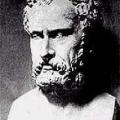
Peter discusses the Pre-Socratic philosopher Pythagoras, as well as Pythagoreanism and the role of mathematics in ancient philosophy.


Themes:
Further Reading
W. Burkert, Lore and Science in Ancient Pythagoreanism, trans. E.L. Minar (Cambridge, MA: Harvard University Press, 1972).
C. Huffman (ed.), A History of Pythagoreanism (Cambridge: 2014).
Iamblichus, On the Pythagorean Way of Life, trans. J.M. Dillon and J. Hershbell (Atlanta: Scholars Press, 1991).
C.H. Kahn, Pythagoras and the Pythagoreans: a Brief History (Indianapolis: Hackett, 2001).



Comments
Assassinate the number 7?
Lakoff & Nunez suggest that the embodied mind brings mathematics into being, so to "assassinate the number 7", wouldn't you simply (!) need to "assassinate all humans"?
Are there any Ancient Philosophers who thought this way, or did they all follow Pythagoras in thinking of numbers as something "out there", existing in an "ideal space" forever?
In reply to Assassinate the number 7? by Malcolm
Mathematics as mental constructs
Perhaps Aristotle comes closer to this kind of view than Plato, since he talks for instance of geometrical figures as being made out of "intelligible matter." In a few episodes I'll be doing an interview with Serafina Cuomo, an expert on ancient mathematics, so you may find that that sheds some further light.
Universe is made from numbers - Pythagoras
This podcast has a wonderful sychronicity to the interview I listened to last week on vortex-based mathematics. One of the quotes from that broadcast of Feb 2013: "Numbers are three dimensional living geometry"
Beans
I have heard a hundred times now that Pythagoras said not to eat beans. However, i was browsing through Voltaire's Philosophical Dictionary, under the entry EMBLEM is the following:
". . . .
Abstain from beans.--Flee frequently public assemblies in which one gave one's suffrage with black or white beans.
. . . . Such are the maxims of Pythagoras, the sense of which is not hard to understand."
So is the whole bean thing really about casting votes?
Love the podcasts, thanks very much.
Graham
In reply to Beans by Graham
Beans
Oh, that's an interesting theory! I quite like that, although I thought that they voted with pebbles rather than beans, at least in Athens.
It strikes me that today's
It strikes me that today's "new age" philosophies could be seen as a resurgence of Pythagoreanism.
Musical ratios and the sound of linear and exponential harmony
Picture a 4 stringed banjo - all the strings are the same length. I turn the first tuning key one full turn;the second two full turns; the third three full turns; the forth four full turns.
From this perfectly tuned Pathagorean instrument (the total number of turns is 10; the perfect number) will I hear the ratios or the perfect sound of linear mathematics. And would you have to turn the third key 4 times and the forth key 16 times to be able to hear what the ratios of exponential growth sounds like albeit it's no longer a perfectly tuned Pathagorean instrument any more. I have to think linear would sound better than exponential
Anyone out there have a stringed instrument to try this in order to hear the results. I wonder if our minds would find the notes pleasurable or would only those minds in mathematical harmony find them pleasant?
A very mediocre approach to my culture and Pythagorean tradition
You aproach the Greek tradition in a very sneaky, lame and rushed way. Instead of saying the GREEK island of Samos you say off the coast of Ionia, which was also GREEK. You also did the disrespectful thing to doubt the integrity of hundreds of philosophers and scholars by “announcing” to us that the Pythagorean theorem is not really by Pythagoras. Like we didn’t know the tradition. Also there is no evidence that Pythagoras took any mathematics from Egypt, so unless you have any hard evidence stop perpetuating the words of non-Greek philosophers such as Iamblichus who lived almost 1000 after his time and did not have the primary sources to prove that either... He wasn’t even a great Orphic to be honest which makes him even less relevant to Pythagoras. You are definitely no Thomas Taylor and you don’t represent the Greek tradition in any shape and form to us. So if you are going to claim the word history in your title make sure you do it right... You didn’t even get right the “Let no One Ignorant of Geometry Enter” that was outside the platonic academy. So yeah, your attempt it’s pretty mediocre...
In reply to A very mediocre approach to my culture and Pythagorean tradition by Antonios Chrys…
Pythagoras
Gosh! That's probably the most rude and abusive comment I've ever had here on the site, after 10 years or so of doing the podcast. Rather a dubious distinction for you to claim. If you do keep following the series you'll probably eventually realize that it is, among other things, a many-hours long love letter to classical Greek culture (and more recently, Byzantine culture) so you may in time to feel rather ashamed of what you've written here in the heat of the moment - if you don't already.
As for the substantial point you raise, the sad fact is that we basically know nothing about the historical Pythagoras, if he was even a real person. So discussion of him is really always discussion of later legends and presentations of him as a mythic figure. Iamblichus is one of the main sources for that tradition, which is really what I was trying to address in this episode.
In reply to Pythagoras by Peter Adamson
Not abusive, truthful
Mr. Adamson,
I am a long time listener of your podcast since the beginning and felt I needed to chime in here. His statement is not abusive, it is truthfully forceful. Scholars outside of Greece like to think of themsevles as the key holders of the Greek tradition, this is far from true. In actuallity they do damage in many cases by casting doubt whenever possible. If you truely think of yourself a philosopher, the Greek kind, I would hope you could reflect on the statement and see where your position could be amended.
In reply to Not abusive, truthful by Angelo Nasios
Eastern Influence upon "Greek" Philosophy
First of all, i hope that you noticed already that the Pythagorean Theorem was already known to Mesopotamians and Egyptians. Secondly, "Greek-Language" Philosophy arose in Asia Minor not in the Greek Mainland, to be more precise in Miletus, which was then part of the Persian (Achaemenid-) Empire. It is VERY unlikely that all the variety of ideas in Pre-Socratic and platonic philosophy can be solely traced back to Greek-Mythology/Homer's and Hesiod’s Epics + "Greek rationalism"* GENIUS of Greek-Mind. Eminent scholars like Walter Burkert, M.L. West, Phillip Horky, Peter Kingsley etc. have shown how Heraclitus, Empedocles, Plato, Democritus etc. borrowed directly or indirectly Non-Greek, specially Egyptian and Zoroastrian (Persian) Ideas. The link between Heraclitus and Zarathushtra is even mentioned in Nietzsches "Philosophie im tragischen Zeitalter der Griechen".
As Herodotus (who was a Hellenized Carian from Harlicanassus) mentioned (Book 1. 146.), Miletus was inhabited by Carians before the Greek-Colonialization. When Greek's arrived (heavily outnumbered by the autochtunus People) they would start mixing with the inhabited Population and the large Population started to adopt Greek language/culture and became hellenized. The Ionian Greek language (attic-dialect) would become lingua franca in the West Coast of Asia Minor, prior to the Conquest of Alexander. As i have stated before the Milesians would be largely Hellenized Carians . Herodot makes also clear, that Thales was of remote Phoenician descent See: Herodot, Book I,170. Names like f.e. Anaximandros are Carian-Style names and make clear that Milesians Thinkers had some Carian origins. see: Luwian Identities- Culture and History of the Near East. S
o the (Attic-Greek) language would be lingua franca on the West-Coast of Asia Minor and later also in other places like Pamphylia (Luwian in origin) etc.
Many so called Pre-Socratic Thinkers weren't even Greek Ethnics necessarily, f.e. Thales was of Phoenician origin just like Pherecydes of Syros, Anacharsis was a Scythian, the Milesians were technically speaking Hellenized Carians etc. Other prominent "Greeks" were of mixed origins too: Thukydides had some Thracian ancestry and Demosthenes was Scythian on his maternal side, Alcman was very likely Lydian origin just like Xanthus of Lydia etc.
So many thinkers who worte in Greek in Antiquity were not necessarily Greek-Ethnics nor does the presented ideas of "Greek-origin". The same way Europeans wrote their works in Latin (f.e. Descartes, Spinoza) without being Roman or Persians wrote in Arabic without becoming Arab (f.e. Avicenna).
Since you have mentioned Iamblichus, he is not the only great thinker who wasn't of Greek descend. Same applies to Plotinus (native Latin-speaker), Porphyry, Origen, Zeno (the founder of the Stoic-school of thought, who was a Phoenician), Arcesilaus (founder of Academic Skepticism) had some Thracian ancestry-his father’s name was Thracian origin Seuthes, etc.
Even the Great Alexandrian Mathematicians are falsely portrayed as being Greek without any sound argument or evidence, see Katz:
"But what we really want to know is to what extent the Alexandrian mathematicians of the period from the 1st to the 5th centuries AD were Greek. Certainly, all of them wrote in Greek and were part of the Greek intellectual community of Alexandria. Most modern studies conclude that the Greek community coexisted ... So should we assume that Ptolemy and Diophantus, Pappus and Hypatia were ethnically Greek, that their ancestors had come from Greece at some point in the past but had remained effectively isolated from the Egyptians? It is, of course, impossible to answer this question definitively. But research in papyri dating from the early centuries of the common era demonstrates that a significant amount of intermarriage took place between the Greek and Egyptian communities ... And it is known that Greek marriage contracts increasingly came to resemble Egyptian ones. In addition, even from the founding of Alexandria, small numbers of Egyptians were admitted to the privileged classes in the city to fulfill numerous civic roles. Of course, it was essential in such cases for the Egyptians to become "Hellenized", to adopt Greek habits and the Greek language. Given that the Alexandrian mathematicians mentioned here were active several hundred years after the founding of the city, it would seem at least equally possible that they were ethnically Egyptian as that they remained ethnically Greek. In any case, it is unreasonable to portray them with purely European features when no physical descriptions exist."
— Victor J. Katz (1998). A History of Mathematics: An Introduction, p. 184. Addison Wesley,
So better not to complain, but to enjoy the fact, that “Greek-Civilization” gets the support Euro-centrist scholarship, trying to attribute nearly all achievements to the Greeks. ;)
In reply to Eastern Influence upon "Greek" Philosophy by Daniel
The Greeks
Yes, many of the points you make here are covered elsewhere in the series (e.g. in our coverage of Egypt/ancient Near East in the Africana series, or that Avicenna was not an Arab, etc). Generally I would warn against being too obsessed about what can and cannot be ascribed to "the Greeks" since that is itself a rather unclear category of people: as you point out, many people who wrote in Greek (from Thales to Iamblichus) were not from Greece. As so often, historical categories get fouled up by partisans of modern-day nationalism of one form or another, and that also brings heated emotions into the historical debate; examples of which we can see in the discussion thread above.
In reply to The Greeks by Peter Adamson
GREEKS
Dear Prof. Dr. Peter Adamson,
i think is speak for many other People when explaining that the "obsession" with going deep into "Greek-ness" debates, because some western-scholars try to attribute everything to Greek-Culture and portray all the great Thinkers as being Greek-Ethnics.
Attempts to indicate how the "Greeks" in Asia Minor were able to utilize from a variety of ideas from Persia, Phoenicia and Egypt (Influences from India are indeed very unlikely given the distance between the two cultural spheres) are apologetically neglected.
One may take a look on how Burkert indicated Persian influences ( which is not far fetched given the fact that nearly 3/4 of the Greek speaking world was Persian Subject) on Anaximander.
http://www.rhm.uni-koeln.de/106/Burkert.pdf
That being said, i really hope to see Iranian and Chinese Philosophy covered in this magnificent Podcast too, otherwise there would be a huge Gap in the Philosophy without any Gaps.;)
Best regards
In reply to GREEKS by Daniel
Greek obsession
Well, quite! Of course the original Greek obsession was on the side of scholars who wanted to ascribe everything worthwhile in antiquity to the Greeks. I just wanted to say that one shouldn't fall into the trap of just reversing that Eurocentric discourse, since part of the problem is that the whole Greek/non-Greek contrast is problematic in the first place.
To be honest I doubt I will manage to get back to ancient Persian culture in the foreseeable future; not that it wouldn't be a fine idea, but the time to do it would have been as background for the Islamic world series. (Or back when I did classical antiquity: I should really have done episodes on Babylonia, Persia, and Egypt, alongside the "Greeks", and we only partially corrected that oversight in the Africana series. When I started the podcast back in 2012 I had a more limited conception of the remit of the podcast.) But as you may have seen in my other comments, classical Chinese philosophy is on the way soon, it will come right after we do 20th c Africana.
In reply to A very mediocre approach to my culture and Pythagorean tradition by Antonios Chrys…
Welcome, Gus
In case the general readership was too busy reading books to watch "My Big Fat Greek Wedding," I'll just go ahead and point out the obvious that this commentator is none other than Costas "Gus" Portokalos himself.
Go ahead, say any word and he will tell you how it comes from Greek!
Kidding (mostly) aside - it is fun to see this hilarious character come to life in the comments section of this website.
In reply to A very mediocre approach to my culture and Pythagorean tradition by Antonios Chrys…
Pythagoras was Phoenician
Since you mentioned Iamblicus’ ancestry didn’t he say that Pythagoras himself was of Phoenician origins because both parents were Phoenician?
In reply to Pythagoras was Phoenician by David Bacote
Pythagoras' birthplace
Yes I think that's right; according to Iamblichus he was born in the Phoenician city of Sidon and grew up on Samos, off the coast.
Harmonizing the Discussion
I have to say that I am admiring you for your courage to post this comment. That shows that you are a just person who does not like to hide. I can understand how my approach can be perceived as harsh, but I was not trying to be abusive or rude.
Also, I think I have given you the wrong impression that I didn’t listen to enough material from your podcast, but I did. I decided to write my comment after hearing several of your podcasts, who according to my understanding had several important gaps...
However I will continue to follow you, since I don’t simply reject people because I disagree with them and I appreciate your love for our culture. In order to rectify my previous act of harshness and should you ever wish to discuss the Greek philosophy and reality in a meaningful way I will be available for you. Especially from the esoteric/philosophical point of view since I am a scholar and a philosopher my self, as well as an Orphic by lineage...
mathematical proof
I am at best an amateur philosopher and relatively ignorant of the history; my training is as a mathematician. But I am interested in learning as much as possible. Pythagoras gets the credit, in mathematical circles, for being the one to establish proof as the pre-requisite for the acceptance of mathematical truth; or at least the Pythagorean community gets that credit and I assume justly. My question is, did he have that same influence within philosophy in general. I understand that one of the characteristics of philosophers is that they at least attempt to make a coherent argument for what they claim, and my limited knowledge of Plato suggests that he does indeed make such arguments. I also understand that "proof" in a philosophical context is somewhat problematic since the subject matter is so much more complex and imprecise than in the mathematical context. Did Pythagoras spur philosophy in general toward the use of proof as far as that was possible? If so, that would seem to me to be the most essential contribution Pythagoreans made to philosophy and the Western tradition.
In reply to mathematical proof by Carroll Boswell
Proof and Pythagoras
Interesting question. We don't know much securely about Pythagoras himself, but more generally Pythagoreanism was obviously important in the development of Greek mathematics and it would be fair to say that ancient mathematics (also Egyptian) was from early on taken as a paradigm of proof. So for instance Plato and Aristotle already refer to mathematical proofs as models of how knowledge should work - Euclid would be an early high point in terms of complete extant texts, but we can ascribe some of this mathematical activity to broadly Pythagorean figures. So, the answer is yes, as long as we don't try to tie it too strongly to this one more or less mythical figure called Pythagoras.
Are there any Ancient
Are there any Ancient Philosophers who thought this way, or did they all follow Pythagoras in thinking of numbers as something "out there", existing in an "ideal space" forever?
In reply to Are there any Ancient by dsok
Mathematical objects in antiquity
There was actually a range of views about this antiquity. The obvious thing that leaps to mind would be Aristotle's critique of the Platonic/Pythagorean approach at the end of the Metaphysics so you might have a look at that though it is not easy reading!
Correction
The Romans didn't "push out" the Greeks from Magna Grecia (Sicily and southern Apennine peninsula) but simplyinvaded them. The conversion in identity, and langauge from Greek to Latinized langauge (a dialectof Italian) happened gradually onlyafter 15-16th century AD with religious conversions too. Some "Griko" langauge is still preserved
In reply to Correction by Elena B
Invading
Yes, good point - wrote this one a long, long time ago obviously but I guess I didn't mean to suggest that the Greek speakers all had to leave, only that it was a change of political dominion. Sorry if this was misleading.
In reply to Correction by Elena B
GREEK DIDN'T PUSH OUT NATIVE ANATOLIANS
The very same can be applied to Native Anatolians (Carians, Lycians, Lydians, Pamphylians, Cappadocians) who were not pushed out by Greek Colonialization, but were linguistically Hellenized over Period of time. Languages like Lycian were spoken till at least Third Century CE until they got replaced by Greek.
Greek-speakers who colonized Sicily would interact with natives of Sicily (Sicels, Sicani, Elymians).
This is just a natural pattern that repeats itself over and over again.
In reply to GREEK DIDN'T PUSH OUT NATIVE ANATOLIANS by Daniel
Obsessed with taking down the master
I love this podcast. A lot of the comments seem to be aimed at taking out the master, or the person the obsessional puts in the place of the master so he can 'take him out'.
Hello again, In my attempt…
Hello again,
In my attempt to fill the gaps in my intro-level History of Western Philosophy course, I find myself mentioning women like Aspasia, Hipparchia, and, much later, Hypatia.
But I'm having a harder time with Plato's mother, Perictione. I'm embarrassed to admit I didn't know she was thought to have authored two Pythagorean texts. Apparently it's questionable that she did author them. But, it's fascinating if she was a Pythagorean.
What do you know about Perictione's Pythagoreanism? Is it more than a legend created after her son Aristocles became known as the famous Plato?
Thanks,
Michael
In reply to Hello again, In my attempt… by Michael Aparicio
Perictione
Oh that's funny, just this weekend I was attending an online workshop on women in ancient philosophy and there was an excellent paper presented about Perictione. To make a long story short the material ascribed to her appears in two sources (Iamblichus and Stobaeus), once ascribed to her, once to Archytas, a male Pythagorean. We're talking about late ancient material here. It would be pretty optimistic to take this as evidence that Plato's real mother was a philosopher, whether Pythagorean or not, but it is very intriguing as evidence for women's involvement in the Pythagorean tradition more generally. Also worth noting is that there are letters ascribed to other women Pythagoreans but those are on "domestic" issues (raising children, etc) whereas the Perictione text is about epistemology, the material does not seem at first glance anyway to be at all "gendered." So it is unusual in that respect.
Add new comment